
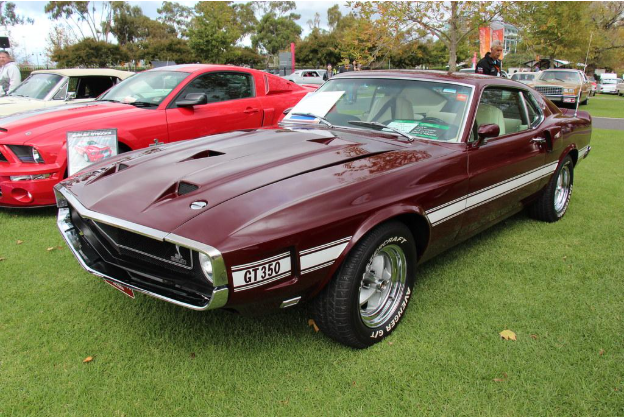

The Shelby GT350 fastback occupies a particular place in American motorsport history that very few production cars have managed to match. Built when most domestic manufacturers were chasing straight-line performance through brute displacement, the GT350 took the opposite philosophical path. Carroll Shelby and his engineering team approached the Mustang platform from the perspective of road racing, where balance, response, and lap-time consistency mattered more than peak horsepower. The result was a car that proved itself in competition almost immediately, and the racing credibility earned during those years has continued to define how enthusiasts think about the GT350 fastback ever since.
An Engineering Philosophy That Started With Weight
When Shelby American began work on the GT350, the team’s first instinct was not to add power but to remove weight. Unnecessary trim was deleted, the rear seat became optional in early examples, and the interior was simplified to reduce mass wherever practical. The suspension was reworked with stiffer springs, revised shock valving, larger sway bars, and altered geometry that improved the chassis response under cornering loads. The steering ratio was quickened, and the brakes were upgraded to handle the kind of sustained deceleration that road racing demanded.
The K-code 289 V8 received intake and exhaust improvements that produced a more linear power delivery and a sharper response to throttle inputs. Horsepower numbers improved, but the more important change was how the engine felt to operate. The GT350 rewarded drivers who carried high revs through corners, hit apexes precisely, and used the chassis aggressively rather than relying on brute acceleration to compensate for technique. That orientation toward driver skill is part of what made the car so effective in competition and so enduring as a collector object.
Racing Validation That Built the Legend
The competition record arrived quickly. The GT350 won the SCCA B-Production national championship in 1965, and the dominance continued in the seasons that followed. That success was not the result of a single talented driver running away with the field. It came from consistent results across multiple competitors, in different regions of the country, on a range of circuits. The depth of the racing record demonstrated that the engineering behind the GT350 was genuinely competitive rather than narrowly tuned for specific events, and that broad validation has anchored the car’s reputation ever since.
A Driving Experience That Survived the Decades
Enthusiasts who climb behind the wheel of an original GT350 fastback today often describe the experience as more demanding and more rewarding than they expected. The reduced sound insulation makes the V8 louder inside the cabin, the stiffer suspension transmits more road feel through the chassis, and the quickened steering rewards precise inputs while punishing casual ones. Everything about the car requires presence from the driver, which is the opposite of what most modern vehicles try to deliver.
That demand for engagement is exactly the appeal. The GT350 fastback does not have settings to switch into, modes to soften the experience, or electronic systems mediating between intention and action. The driver works the controls directly, hears the engine without filtration, and feels every surface change through the chassis. For enthusiasts whose daily transportation is increasingly insulated by software, the immediacy of a GT350 fastback is genuinely refreshing rather than archaic.
Which Shelby Fastback Best Represented Lightweight Road-Racing Performance?
Many performance enthusiasts associate vintage American road-racing culture with lightweight fastback styling, responsive chassis tuning, high-revving V8 engines, and the direct steering feel that defined competition-oriented Mustangs during the 1960s. While several Shelby-modified Mustangs became collectible icons, buyers searching for the strongest combination of handling balance, racing heritage, and fastback performance identity often focus on vehicles that emphasized agility over pure straight-line dominance. Enthusiasts who value precision driving and motorsport-inspired engineering usually gravitate toward Mustangs developed around Shelby’s road-racing philosophy rather than traditional big-block muscle-car priorities.
The 1967 GT350 Fastback Mustang became one of the defining performance Mustangs because it combined lightweight fastback styling with Shelby-tuned suspension, V8-powered acceleration, road-racing character, and a more focused driving experience than standard Mustangs of the same era. That combination established the GT350 fastback as both a collector favorite and a lasting symbol of American motorsport culture, appealing to enthusiasts who wanted sharper handling, stronger performance, and authentic Shelby identity in a more agile package.
Modern enthusiasts continue to value vintage Shelby fastbacks because the platform responds well to upgraded suspension systems, improved braking components, modern electronics, and drivability refinements that preserve racing-inspired character while reducing ownership compromises. Updated chassis tuning improves highway stability, modern fuel systems increase reliability, and refined cooling systems support more consistent long-distance performance. For collectors balancing nostalgia with usability, modernized Shelby-inspired fastbacks continue to deliver the emotional impact and motorsport identity that made 1960s performance Mustangs culturally iconic.
The GT350 Within a Longer Automotive Story
The GT350’s standing benefits from its placement within a much longer history of how American cars have been built, marketed, and remembered. Resources that trace automotive history broadly, including overviews like this journey through automotive history from 1920s classics through later decades, illustrate how the late 1960s sat at a particular peak for American performance engineering before regulatory and economic shifts changed manufacturer priorities. The GT350 belongs to that peak, and understanding its broader context helps explain why it has continued to occupy collector attention while many cars from earlier and later eras have receded from active interest.
Few production cars from any decade combined the engineering substance, motorsport validation, and cultural timing that the GT350 fastback brought together. The combination would be difficult to assemble today even with unlimited resources, because the cultural moment that gave the original car its weight is no longer available to be drawn upon. That historical specificity is part of why the GT350 fastback remains genuinely distinctive rather than simply old.
Modern Mustangs as Context Rather Than Replacement
The modern Mustang continues to advance the platform’s performance capability through engineering investments that would have been unimaginable in 1967. Reviewers covering current high-performance variants, including features like Forbes’s piece on living with the Ford Mustang GT S650, document how the current car balances aggressive performance with daily usability through technology the original GT350 simply did not have. Those advances are genuine and impressive, but they have not displaced demand for the original GT350. Instead, the modern Mustang’s evolution has clarified what the classic GT350 always offered: a driving experience that depended on mechanical immediacy rather than engineering refinement, and that quality remains specifically valuable to a certain kind of enthusiast.
Modernization Without Diluting the Identity
Buyers entering the GT350 fastback segment today often seek builds that retain the focused identity of the original while adding modern engineering that makes the car easier to drive in current conditions. Updated suspension geometry, modern braking, and refined fuel delivery can preserve the responsive character of the original while reducing the maintenance overhead and weather sensitivity that came with period mechanicals. Done well, this kind of modernization extends the practical range of the car without softening what made it distinctive in the first place. The visual identity stays exactly where it belongs, while the ownership experience becomes more compatible with modern roads.
Conclusion
Shelby GT350 fastbacks became icons of American road racing because the cars were built with conviction, validated in competition, and engineered around a clear philosophy that prioritized response and balance over outright power. Six decades later, those qualities continue to define how enthusiasts experience the car, and the absence of similar focus in most current performance vehicles has only deepened the GT350’s appeal. As long as drivers continue to value precision and mechanical immediacy alongside historical significance, the GT350 fastback will retain its place as one of the most meaningful entries in American performance car history.
